Process
How we go from a brief to a finished design.
Three steps
Each step comes from a research result: model ideas converge, taste is personal, and revision drifts back to the usual.
01
Generate widely.
Every idea starts from a different seed, so the set holds many more distinct ideas than a model gives on its own.
02
Let the person choose.
Taste is personal, so the person picks, blind to where each idea came from. Whether their picks can teach the system what to make next is still being tested.
03
Develop with care.
The chosen idea becomes a model and drawings. A critic reviews each round, and fresh outside material keeps it from drifting back to the usual. Whether that makes it better, and not only different, is not yet shown.
The roles
Each role is a model with one job. The founder sets the brief and makes the final calls.
- DesignerWrites many ideas for the brief, each from a different seed.
- DirectorKeeps the brief, the person’s picks and the schedule in view.
- ModellerTurns the chosen idea into a model and drawings.
- CriticReviews every round and says what is still generic.
What it made
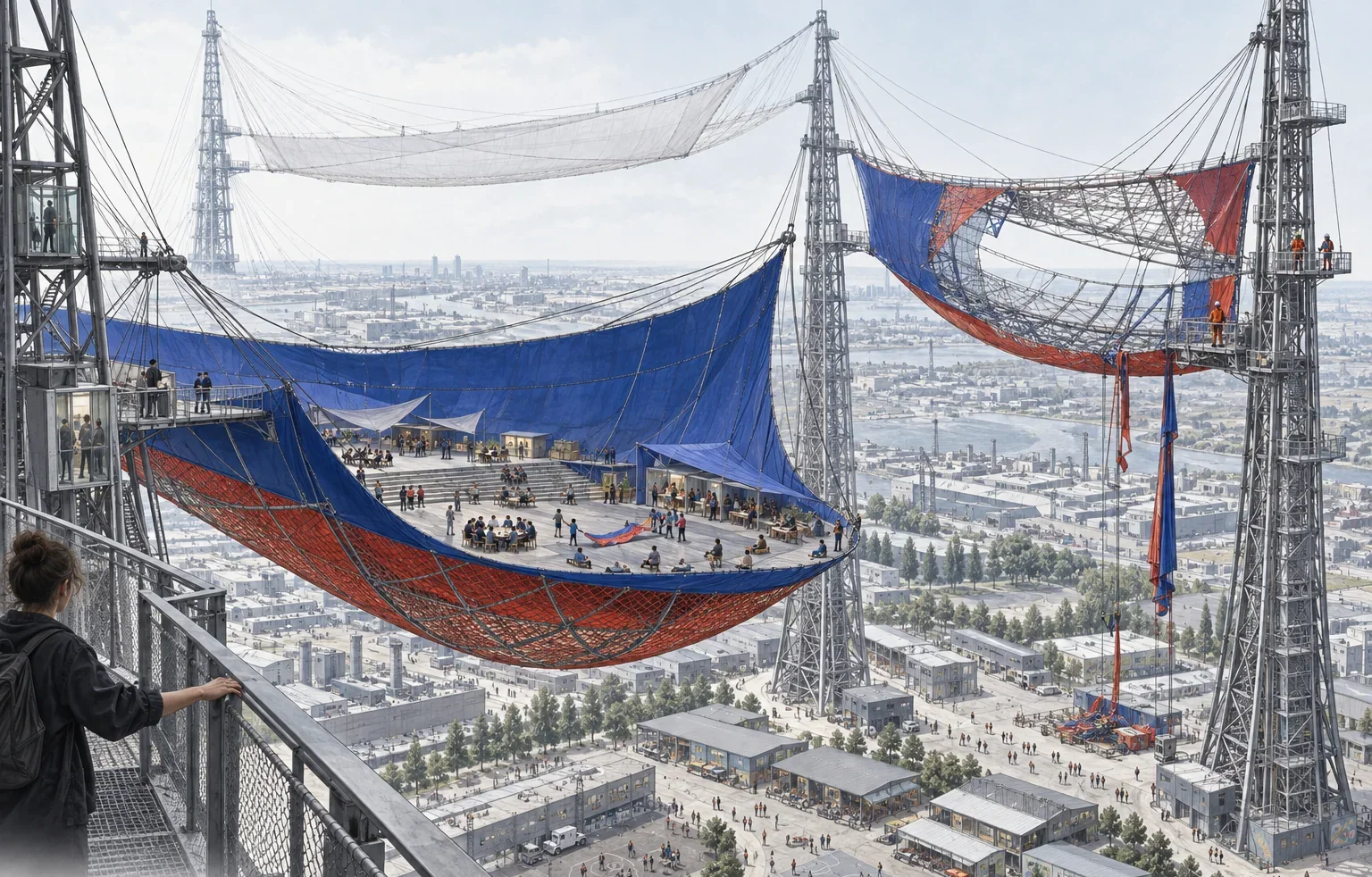
Our first brief was the eVolo Skyscraper Competition. Three designers, each a model, took one question apiece: territory, gravity and time. Their ideas are on the home page. A fourth combined them into one design, and our director chose to develop it. Architects have not yet rated it blind. It came before the seeded generator, so it shows the studio at work, not a test of the three steps.
What is shown so far
Our tests so far use distance measures, public ratings and AI judges, on one or two briefs each. No group of architects has rated our designs yet. Here is where each step stands.
-
Step 1
Generate widely
Shown. On two competition briefs, plain prompting gave 3 to 4 distinct ideas in 40. Seeded sets gave 7 to 14, against 11 to 16 in 40 real entries.
Not shown. That the spread is good. By an AI judge, the further an idea sits from the real entries, the less it is preferred to them. Far from other entries is also not the same as new: against built precedent, the concepts our generator made by selecting for distance were no newer than real entries.
-
Step 2
Let the person choose
Shown. About 44% of a rating is stable and personal, twice the shared part. On public joke ratings, a selector that learns from one person’s ratings picks the favourite of three jokes about 6 points more often than a shared one, after 80 ratings.
Not shown. That this works on designs. That a person has a favourite distance from the usual: tests on jokes and on art found a lean toward or away from the unusual, not a sweet spot. That architects prefer what the system makes. The blind round that tests this is built and has not run.
-
Step 3
Develop with care
Shown. One museum entry went from brief to four drawn boards. Over four rounds, ideas revised with fresh outside material stayed far from the field where a closed loop drifted back toward it. Random fragments did as well as real material.
Not shown. That the rounds make ideas better. An AI judge liked the concepts less after four rounds, with or without outside material, and read from its drawn boards, the entry sits inside the range of real entries, not beyond it. The critic is a model too, and in our runs a model director, not a person, made the choice.
Where each part stands
-
Live
Framework
How more than a thousand people think, written so a model can reason like them.
-
Experiment
The blind-pick test
Pick your favourite of four short pieces, ten times, and see whose thinking your taste follows.
-
In research
The seeded generator
Makes many different ideas for one brief. Seeded ideas are far less alike than plain ones (similarity 0.42 to 0.58 against 0.77 to 0.81).
-
In research
The distance scale
Measures how far an idea is from the usual answer, on one scale from 0 to about 2.
-
Building now
The personal selector
Learns a person’s taste from their picks. Target: match them at 80% of their own consistency within 40 picks.
-
Next
The blind round with architects
Architects rate real competition entries and our concepts, drawn in one style, without knowing which is which. It is the first test of whether people prefer what the process makes.